

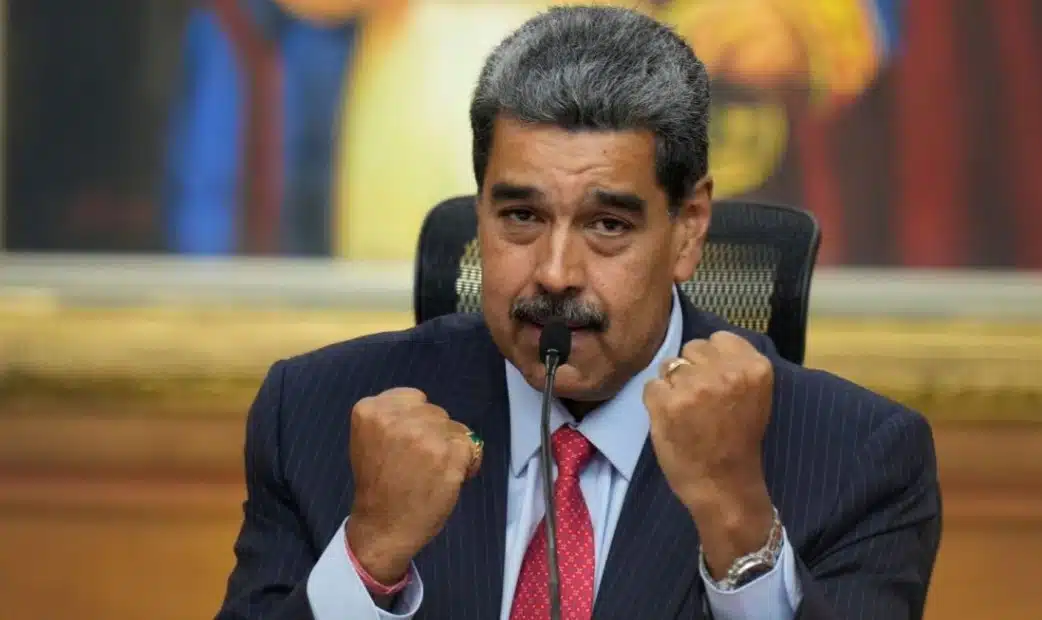
The United States launched what it described as a large-scale military operation against Venezuela early Saturday, with President Donald Trump claiming that Venezuelan President Nicolás Maduro had been captured and flown out of the country. The announcement marks a dramatic escalation in Washington’s months-long pressure campaign against the South American nation.
Trump revealed the operation in a post on his social media platform, Truth Social, shortly after 4:30 am ET. His statement came hours after multiple explosions and low-flying aircraft were reported over the Venezuelan capital, Caracas.
“Maduro has been, along with his wife, captured and flown out of the Country,” Trump wrote, adding that the operation was carried out “successfully” in coordination with US law enforcement agencies. He said further details would be shared at a news conference later in the day.
However, as of Saturday afternoon, independent confirmation of Maduro’s capture was not available, and it remained unclear who was effectively in control of the Venezuelan government.
Venezuela Accuses US of ‘Imperialist Attack’
Venezuela’s government quickly condemned the operation, accusing the United States of launching attacks on civilian and military installations. In an official statement, authorities described the strikes as an “imperialist attack” and urged supporters to mobilise and take to the streets in defence of the country.
Despite Trump’s claims, Maduro’s exact whereabouts were unknown beyond the US president’s statement. Venezuelan officials did not confirm that the president had been captured, and state media continued broadcasting messages calling for calm and resistance.
What Happened Overnight in Caracas
Residents of Caracas reported at least seven explosions in the early hours of Saturday as military aircraft flew at low altitude over the city. According to witnesses cited by Reuters, black smoke was seen rising from several areas starting around 2 am local time (0600 GMT).
Smoke was reported from a hangar at a military base in Caracas, while another military installation experienced a power outage. Several neighbourhoods were left without electricity hours after the strikes, though traffic continued to move in parts of the city.
Videos verified by the Associated Press showed tracer fire and smoke filling the night sky over Caracas and at least one unidentified coastal city. Repeated explosions illuminated nearby hills, while other footage showed vehicles continuing to move on highways as blasts lit up the background.
“The whole ground shook. This is horrible. We heard explosions and planes,” said Carmen Hidalgo, a 21-year-old office worker. “We felt like the air was hitting us.”
Streets Show Mixed Reactions
In some strongholds of the ruling party, armed civilians and pro-government militia members were seen on the streets. In contrast, other neighbourhoods remained largely deserted several hours after the strikes, with residents staying indoors amid uncertainty and fear.
Public transport services were disrupted in parts of the capital, and security forces were seen increasing patrols around key government buildings.
No Immediate Clarity From US Agencies
While Trump claimed the operation was coordinated with US law enforcement, American military and intelligence agencies have not yet released detailed statements explaining the scope, objectives, or legal basis of the strikes.
It was also unclear whether the operation had support from US allies or how it aligned with international law. Analysts warned that if confirmed, the capture of a sitting head of state would represent a major turning point in US–Latin America relations.
What Comes Next
With conflicting claims and limited verified information, the situation remains fluid. Global leaders are closely monitoring developments amid fears of regional instability, civilian harm, and diplomatic fallout.
Further clarity is expected once US officials hold the promised press conference and Venezuelan authorities issue additional statements. Until then, questions remain over Maduro’s status, Venezuela’s leadership, and the broader consequences of the US action.