

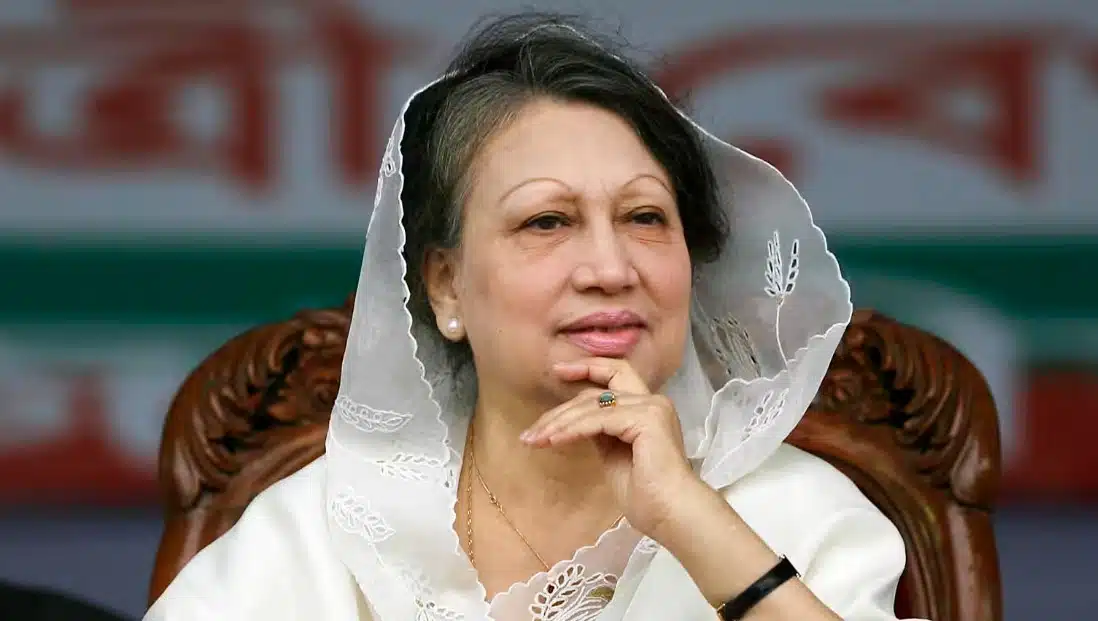
Khaleda Zia, Bangladesh’s first woman prime minister and a towering figure in the country’s political history, died on Tuesday at the age of 80 following a prolonged illness, the Bangladesh Nationalist Party (BNP) said in a statement.
Zia had been suffering from multiple health complications, including advanced liver cirrhosis, arthritis, diabetes, and heart ailments. She was undergoing treatment at a private hospital in Dhaka.
A three-time prime minister, Khaleda Zia played a central role in shaping Bangladesh’s modern political landscape and remained one of South Asia’s most influential leaders for decades.
Early Life and India Connection
Khaleda Zia was born in 1945 in Jalpaiguri, then part of the undivided Dinajpur district of British India (now in West Bengal). Following Partition, her family moved to Dinajpur in present-day Bangladesh. She studied at Dinajpur Missionary School before attending Dinajpur Girls’ School.
Her political journey began after the assassination of her husband, President Ziaur Rahman, in a 1981 military coup. In the aftermath, she rose rapidly within the Bangladesh Nationalist Party (BNP), becoming its chairperson in 1984.
Political Career
Khaleda Zia became Bangladesh’s first woman prime minister in 1991 after leading a popular movement that restored parliamentary democracy. Her government introduced major reforms, including the reintroduction of the parliamentary system, establishment of the caretaker government mechanism, and key economic initiatives such as VAT, the Bank Company Act (1991), and the Financial Institutions Act (1993). Her tenure also focused on expanding access to education.
She briefly returned to power in 1996 and later won a decisive mandate in 2001 after forming a four-party alliance. During her terms, she positioned herself as a strong political rival to Sheikh Hasina, leader of the Awami League.
Arrests, Exile and Return
Following political unrest, Khaleda Zia was arrested in 2007 on corruption charges and later sentenced to 17 years in prison in the Zia Orphanage Trust and Zia Charitable Trust cases. She was released in 2024 after years of imprisonment and deteriorating health.
Despite setbacks, she remained politically active and was honoured in 2011 by the New Jersey State Senate as a “Fighter for Democracy.”
India Engagement
Khaleda Zia maintained notable ties with India. She visited India in 2006 and again in 2012, meeting then President Pranab Mukherjee, Prime Minister Manmohan Singh, and opposition leader Sushma Swaraj. Prime Minister Narendra Modi also met her during his 2015 Bangladesh visit.
Final Years
Despite years of illness, Khaleda had expressed her intention to campaign in the February 2026 general elections following the fall of the Sheikh Hasina-led government. Plans to airlift her to London for advanced treatment earlier this month were shelved due to her fragile condition.
Her son, Tarique Rahman, returned to Bangladesh last week after 17 years in self-imposed exile and is expected to lead the BNP in the upcoming February 12 general election.
Khaleda Zia leaves behind a lasting legacy as a central figure in Bangladesh’s democratic evolution and one of the most influential women leaders in South Asian political history.