

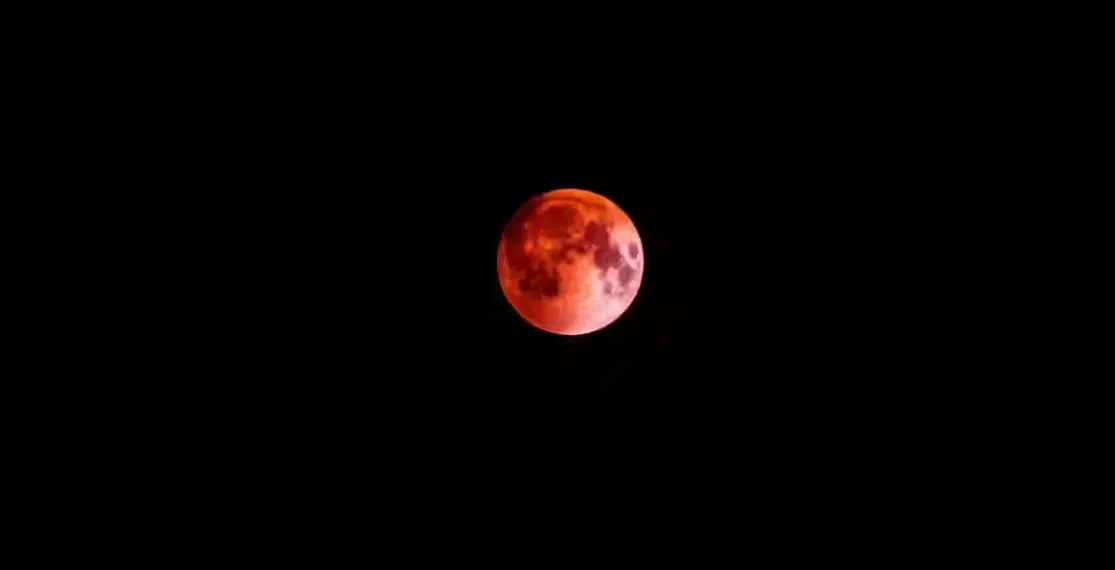
The sky is set for a breathtaking celestial event today as the March 2026 full moon transforms into a glowing Blood Moon during a total lunar eclipse. This rare astronomical phenomenon will be visible across much of the world, including the United States, providing a spectacular show for both casual skywatchers and astronomy enthusiasts.
What Is a Blood Moon?
A Blood Moon is the popular name for a total lunar eclipse, a phenomenon that occurs when the Earth passes directly between the Sun and the Moon, casting a shadow over the lunar surface. Unlike a solar eclipse, a lunar eclipse is completely safe to view with the naked eye, although binoculars or telescopes can enhance the experience.
During totality, the Moon takes on a reddish or orange hue. This happens because Earth’s atmosphere bends sunlight, allowing only the longer red wavelengths to illuminate the Moon. The exact shade of red varies depending on atmospheric conditions, creating a unique display every time.
When and Where to See the March 2026 Lunar Eclipse
Timing is everything for observing this stunning event. Here are the key phases of the total lunar eclipse on March 3, 2026 (all times local to the U.S. Eastern Time Zone unless noted):
- Full Moon: 6:38 A.M. EST
- Eclipse Start (Penumbra): 3:43 A.M. EST – The Moon begins entering Earth’s outer shadow
- Partial Eclipse Begins (Umbra): 4:49 A.M. EST – The Moon noticeably darkens
- Totality Begins: 6:03 A.M. EST – The Moon turns its signature reddish-orange
- Totality Ends: 6:02 A.M. CST – Visible in the Midwest at a low western horizon
- Eclipse End: 6:23 A.M. PST – The Moon exits the penumbra completely
Note: Exact visibility depends on your location. Observers in the western U.S. will enjoy a longer view of the eclipse, while the East Coast will see it near sunrise.
Additional Lunar Facts for March 3:
- Moonrise: 6:24 P.M. local time
- Moonset: 6:33 A.M. local time
- Sunrise / Sunset: 6:30 A.M. / 5:54 P.M. local time
- Moon Phase: Waning gibbous (99% illumination)
Why the March 2026 Eclipse Is Special
This total lunar eclipse is particularly exciting because it is the only total lunar eclipse of 2026, giving skywatchers a rare opportunity to experience a full Moon turning blood-red.
The timing of this eclipse is unusual in some areas because totality coincides with sunrise or moonset, depending on your location. This creates unique viewing conditions where the Moon appears low on the horizon, glowing brilliantly against the early morning sky.
How to Watch the Blood Moon Safely
Unlike solar eclipses, lunar eclipses are completely safe to observe with the naked eye. However, for a better experience:
- Use binoculars or a telescope to see more details of the Moon’s surface
- Photograph with a camera and tripod to capture the red hue
- Find an area with minimal light pollution for a clearer view
- Dress warmly if you’re in the early morning outdoors, and check local weather
The Science Behind the Blood Moon
During the eclipse, the Moon first enters Earth’s penumbra, the faint outer shadow, causing a subtle dimming. It then moves into the umbra, the darker inner shadow, and gradually darkens.
Totality occurs when the Moon is completely inside the umbra. At this moment, the Moon glows red because sunlight is refracted through Earth’s atmosphere. Tiny amounts of sunlight are bent and filtered, removing shorter blue wavelengths and leaving the warmer red light to illuminate the Moon.
This process is similar to what happens during sunrises and sunsets, but projected onto the Moon on a cosmic scale.
Cultural and Astrological Significance
Throughout history, lunar eclipses have captured human imagination and inspired myths, legends, and astrology. Some cultures associate Blood Moons with change, transformation, and new beginnings.
Astrologers suggest that the March 2026 Blood Moon may bring emotional release and opportunities for reflection, especially for zodiac signs ruled by the Moon, such as Cancer, Scorpio, and Pisces.
Tips for Capturing the Best Photos
Photographers don’t want to miss the chance to capture the Blood Moon:
- Use a telephoto lens (200mm or higher) to focus on the Moon
- Mount your camera on a tripod to prevent blur
- Experiment with different exposures to capture the red tones
- Include foreground elements like trees or mountains for dramatic effect
Key Takeaways
- The March 2026 full moon coincides with a total lunar eclipse, turning the Moon a deep red or orange.
- Totality will be visible early morning on March 3 across most of the U.S. and other parts of the world.
- This is the only total lunar eclipse of 2026, making it a rare and memorable event.
- Observation is safe for the naked eye, but telescopes, binoculars, and cameras can enhance the experience.
- Skywatchers and photographers alike should plan to view the eclipse from a location with minimal light pollution for the best experience.
Final Thoughts
The Blood Moon of March 3, 2026 promises to be a spectacular natural show that unites science, culture, and photography in one cosmic event. Whether you are a seasoned astronomer or a casual stargazer, this eclipse is an opportunity to witness one of nature’s most dramatic light shows. Don’t miss it!